
Free playbook · episode 5 · about an hour
Your clients can tell when you used AI. The voice playbook, free.
Your voice, your company and your rules in one place, read before it writes anything.
How everything Origin sends stopped sounding like everybody else.
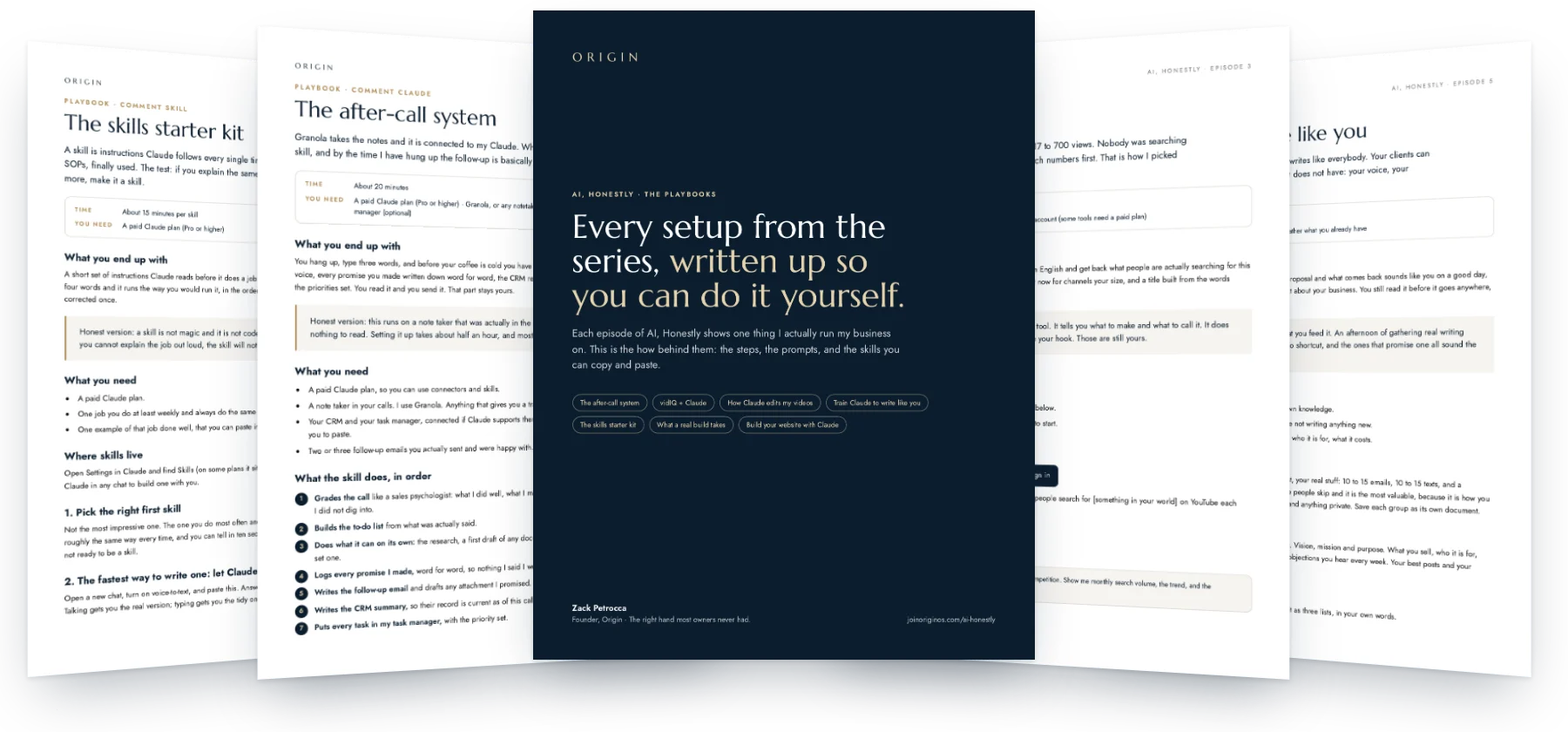
- Voice
- Company
- Rules
- Project
- Sharper
That link expired. Pop your details in and we will send a fresh one.
Takes under 30 seconds. Free, no card.
You will also get The System Drop, our weekly newsletter. One click to leave, anytime. We never sell your information. Privacy.
Why this exists
Out of the box, you are using the same AI as everyone else.
That is why it sounds like everyone else. Same rhythm, same words, same tidy little closer at the end. People read it and feel the distance.
The fix is not a cleverer prompt. It is giving it the three things it does not have: how you actually write, what your company actually is, and the rules you would give a new hire on day one.

Who built this
Only things I actually run.
I am Zack, a fractional COO. I build the operating systems behind founder-led service businesses, and I run my own on Claude. Every playbook here is a system I use every week, written up the way I would walk a friend through it. The one rule under all of it: hand AI the task, never the judgment.
Zack Petrocca, Founder, Origin
What is inside
Three things it does not have, and where to put them.
Most of this already exists. You are gathering, not writing.
-
Your voice
Ten to fifteen real emails, the same in texts, and a call transcript or two.
Try this"Your real stuff, not your polished stuff."
-
Your company
Vision, purpose, what you sell, your sales and marketing docs, the brand guide.
Try this"Gather what exists. Write nothing new."
-
Your rules
Do, do not, and the words you would never use.
Try this"The cringe list is the most useful page you will write."
-
One place it reads first
A Claude Project with the instructions that make it read before it writes.
Try this"Paste the instructions straight in."
-
The weekly sharpening
Every time you correct it, the correction becomes a rule.
Try this"Too formal? Say why, then add it."
About an hour of gathering. Everything it writes after that sounds like you.
Open the playbookLook inside
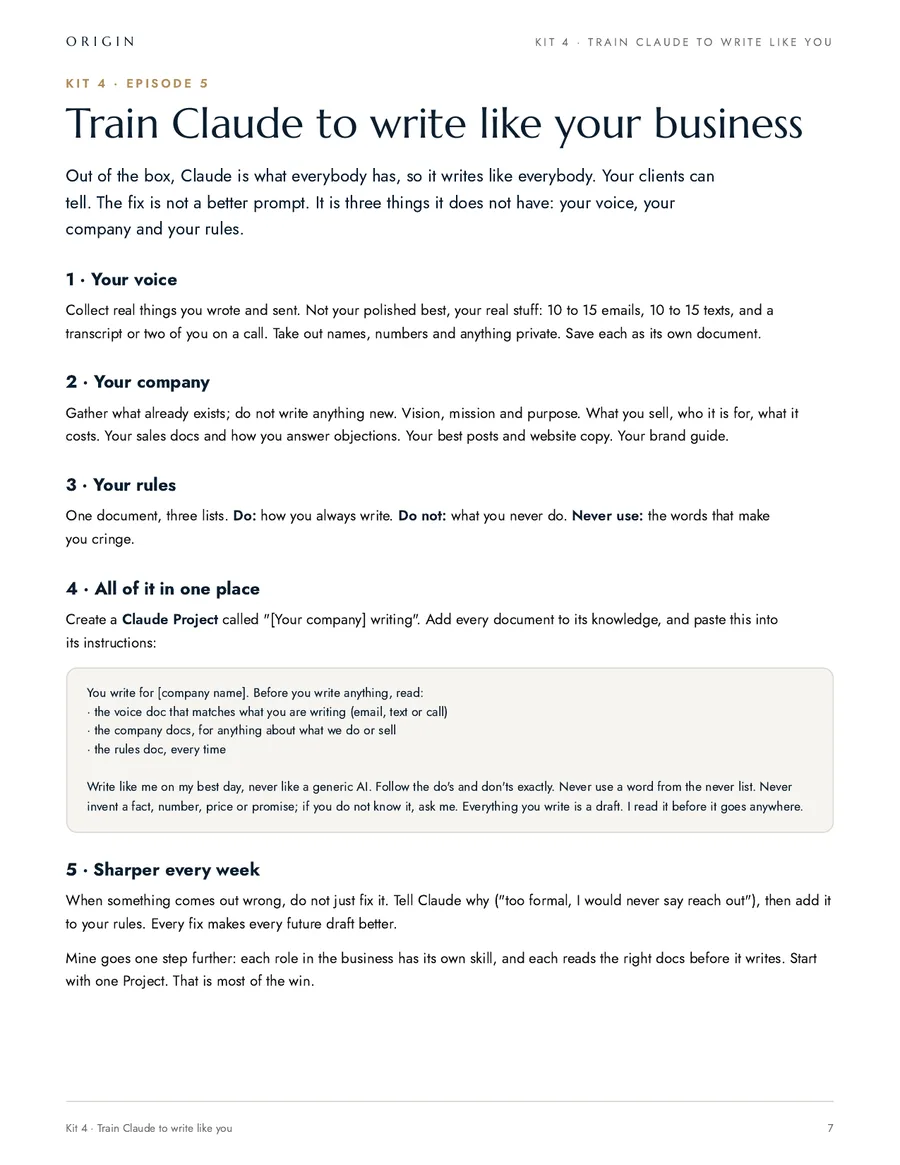
Real pages, not a summary.
Who this is for
This is for you if
- Clients read what you send.
- You have rewritten an AI draft into your own words more than once.
- You want more time on the people, not more words.
Skip it if
- You are happy with generic.
- Nobody outside your company reads your writing.
How fast it pays off
Useful the same day.
-
First ten minutes
Pull 10 emails you actually sent. That alone changes the output.
-
The next hour
Add the company docs and write the rules page.
-
Every week after
Turn each correction into a rule. It gets sharper on its own.
Setup: About an hour. One email opens this playbook and every other one in the library.
Before you open it
Do I need a paid plan?
For Projects, yes. Claude Pro or higher.
Is it safe to give it our documents?
Take out anything private, the same way you would before sending a doc to a new contractor.
How is this different from a good prompt?
A prompt is one moment. This is read before every draft, forever.
Sound like your business. Not like everybody.
Your first name, your email, and the whole library is open.
Open the playbookYou are in. Every playbook is open, and a copy is on its way to your inbox.
AI, Honestly · Episode 5
Train Claude to write like you
Out of the box, Claude is what everybody has, so it writes like everybody. Your clients can tell. The fix is not a better prompt. It is three things it does not have: your voice, your company and your rules.
What you end up with
One place you write from. You ask for an email, a post or a proposal and what comes back sounds like you on a good day, knows what you sell and what it costs, and never invents a fact about your business. You still read it before it goes anywhere, but you stop rewriting it from scratch.
Honest version: the quality of this is the quality of what you feed it. An afternoon of gathering real writing beats any prompt anyone will ever sell you. There is no shortcut, and the ones that promise one all sound the same.
What you need
- A paid Claude plan, so you can make a Project with its own knowledge.
- An hour to gather things you have already written. You are not writing anything new.
- The company documents you already have: what you sell, who it is for, what it costs.
1. Your voice
Collect real things you wrote and sent. Not your polished best, your real stuff: 10 to 15 emails, 10 to 15 texts, and a transcript or two of you on a call. The call transcript is the one people skip and it is the most valuable, because it is how you talk when you are not performing. Take out names, numbers and anything private. Save each group as its own document.
2. Your company
Gather what already exists. Do not write anything new for this. Vision, mission and purpose. What you sell, who it is for, what it costs. Your sales documents and how you answer the objections you hear every week. Your best posts and your website copy. Your brand guide.
3. Your rules
This is the short document that does most of the work. Write it as three lists, in your own words.
# How I write

## Do
- Lead with the point in the first line.
- Short sentences. One idea each.
- Say the real number or say nothing.
- Write like I am talking to one person I like.

## Do not
- Do not open with a pleasantry.
- Do not ask three questions in one email.
- Do not explain something I have not been asked about.
- Do not use a word I would have to look up.

## Never use
- "I hope this email finds you well"
- "circling back", "just checking in", "touching base"
- "leverage", "synergy", "utilize", "robust"
- [add yours here, the ones that make you cringe]
4. All of it in one place
Create a Claude Project called "[Your company] writing". Add every document to its knowledge, and paste this into its instructions.
You write for [company name]. Before you write anything, read:
- the voice doc that matches what you are writing (email, text or call)
- the company docs, for anything about what we do or sell
- the rules doc, every time

Write like me on my best day, never like a generic AI. Follow the do's and don'ts exactly. Never use a word from the never list. Never invent a fact, number, price or promise; if you do not know it, ask me. Everything you write is a draft. I read it before it goes anywhere.
5. Test it before you rely on it
Do not find out it is wrong on something that matters. Give it a job you have already done and compare.
Write the email I would send to [a real situation you handled last month].

Then, separately, tell me which of my documents you used and which lines of the rules you were following.

I am going to compare this to the one I actually sent. Do not try to impress me. Try to sound like me.
Read them side by side. Where it is different, that difference is a line missing from your rules document, not a reason to give up on it.
6. Sharper every week
When something comes out wrong, do not just fix it and move on. Tell Claude why, in the words you would use, then add the line to your rules. Real corrections:
- "Too formal. I would never say reach out."
- "That is three questions. I ask one."
- "You made up a timeline. If I did not give you a date, do not use one."
- "That opening is a warm-up. Start at the second paragraph."
- "Nobody in my world calls it a solution. It is a system."
Every fix you write down makes every future draft better. Every fix you only say out loud gets made again next week.
What goes wrong, and the fix
- It sounds like a press release. You gave it your polished marketing copy and none of your real emails. Add the messy ones.
- It uses a phrase you hate. It is not in the never list yet. Add it, word for word.
- It invents a price or a timeline. Say it once in the instructions: if you do not know it, ask. It will ask.
- Everything comes out the same length. Tell it what you write long and what you write short, with an example of each.
- It is great at emails and bad at posts. Those are two voices. Give each its own document.
Before you send
- Read it out loud. That catches the AI rhythm faster than reading it on screen.
- Check every fact, number and price against something real.
- Cut the first sentence. It is usually a warm-up.
Mine goes one step further: each role in the business has its own skill, and each one reads the right documents before it writes. Start with one Project. That is most of the win, and it is one afternoon.
What happens once it is set up
Their words, not ours.
“I went from an independent contractor to a business owner, and that is what Zack has done for me.”
- $7.3M
- sold last year
- ~$11M
- this year, with pending closings
Numbers as Beau said them, October 2026.
Beau P.Real Estate Team Leader, Empire Real Estate Firm
-
He changed how I actually prompt and use AI day to day, and my results are noticeably better because of it.
Sam O. Founder
Sharper AI, tighter sales
-
Origin brought systems and clarity to a team that really needed it, and did it in a way that stuck.
Carrie A. Events Director, AFSP Long Island Chapter
Clear ownership, AI that stuck
-
He doesn't just talk the talk, he puts his mind to things and gets it done, and then he teaches other business owners how to do the same.
Harlan M. Real Estate Agent
AI from zero: emails to a full website
Free, and I do mean free
Want help setting it up? Book 30 minutes with me.
You bring this playbook and whatever is in your way. We set it up together on the call. No pitch, no card, and if it is not a fit for us to work together I will still leave you with it working.
- Bring your screen. We do it live, not in theory.
- Thirty minutes. If we finish early, you get the time back.
- If you want more after that, we can talk. If not, you keep the system.
The other playbooks
- Episode 2 The after-call system The skill that grades the call, logs every promise, writes the follow-up and updates the CRM.
- Episode 3 vidIQ + Claude The 30-second setup and the five prompts I use to pick every video before I shoot it.
- Episode 4 How Claude edits my videos The honest setup behind the series, and the edit rules that keep every video on brand.
- Episode 8 The skills starter kit The prompt that makes Claude interview you and write the skill, plus three to start with.
- Episode 9 What a real build takes A buyer’s guide to custom software: what AI made easy, the eight parts it did not, and how to tell if you are ready.
- Episode 17 Build your website with Claude The honest process behind a 72-page site: the words first, one page at a time, and the phone test that makes it feel like you.
While you are here