
Free guide · episode 9 · before you build
AI made the code cheap. It did not make software easy.
The honest buyer’s guide to custom software: what AI changed, the eight things it did not, and how to tell if you are ready.
Over 1,500 updates shipped to Origin’s own software since August.
- Honest
- Scope
- Stories
- Ready?
- Ask
That link expired. Pop your details in and we will send a fresh one.
Takes under 30 seconds. Free, no card.
You will also get The System Drop, our weekly newsletter. One click to leave, anytime. We never sell your information. Privacy.
Why this exists
A demo takes an afternoon. A business runs on the rest.
Anyone can get AI to produce something that looks like an app now. What decides whether a team can actually run on it is everything underneath: who can see what, your existing data, the tools it has to talk to, the ugly cases, and every change after launch.
This guide lays those out, with real things that happened while we built our own platform, a readiness check, and the questions to ask anyone who offers to build it for you.

Who built this
Only things I actually run.
I am Zack, a fractional COO. I build the operating systems behind founder-led service businesses, and I run my own on Claude. Every playbook here is a system I use every week, written up the way I would walk a friend through it. The one rule under all of it: hand AI the task, never the judgment.
Zack Petrocca, Founder, Origin
What is inside
What is in the guide.
Written for owners deciding whether, and how, to build.
-
What AI changed
What got cheap, and what did not.
Try this"Faster code is not a finished product."
-
The eight things underneath
What you are actually paying for when you build software.
Try this"None of it shows up in a demo."
-
From our own build
Four real problems AI wrote the code for and did not catch.
Try this"All of them show up in month two."
-
The readiness check
Eight questions that tell you whether to build, buy, or fix the process first.
Try this"Sometimes the answer is not to build."
-
Questions for any builder
Seven questions that show whether someone has done this before.
Try this"Ask them before you sign anything."
Fifteen minutes that can save you from paying for the wrong build.
Open the playbookWho this is for
This is for you if
- You are considering custom software for your business.
- You have been told AI can build it in a weekend and want the honest version.
- You want to know what to ask before you hire anyone.
Skip it if
- You want a template app by this afternoon.
- You are a developer looking for a coding tutorial.
How fast it pays off
Useful the same day.
-
Read it
Fifteen minutes. The eight things underneath are the part most owners never hear about.
-
Take the readiness check
Eight yes or no questions. It tells you whether to build, buy, or fix the process first.
-
Before any first call
Use the brief prompt, and bring the seven questions.
Setup: Fifteen minutes to read. One email opens this playbook and every other one in the library.
Before you open it
Is this how Origin’s software was built?
Yes. Over 1,500 updates since August. Claude wrote most of the code. The eight things in this guide were most of the work.
Can I build it myself?
A small tool for one person, often yes. Software a whole team runs a business on is a different job, and this guide shows you what that job includes before you decide.
Can Origin build it for us?
Yes, that is part of what we do. Take the Origin Diagnostic or book a call, and bring your brief.
Know what it takes. Then decide.
Your first name, your email, and the whole library is open.
Open the playbookYou are in. Every playbook is open, and a copy is on its way to your inbox.
AI, Honestly · Episode 9
What a real build takes
I am not a developer, and over 1,500 updates have gone into the software my company runs on, built with Claude. So here is the honest version. AI made writing code cheap. It did not make building software easy. This guide is what actually decides whether custom software works, drawn from our own build.
What AI changed, and what it did not
What AI made easy
- Writing the code
- A first version you can click through
- Screens that look finished
- Changes in minutes instead of weeks
What it did not
- Knowing what to build
- Who is allowed to see what
- Moving years of your data in safely
- Making sure a change does not break what already worked
A demo that looks finished takes an afternoon now. Software a team can run a business on still takes judgment, testing and time. Most of the cost is in the part you cannot see.
The eight things underneath
Screens are what you see. These are what you are actually paying for, and every one of them came up in our own build.
Who can see what
Your salesperson should not see payroll. A client should see their project, not the next client’s. Every screen, report and export has to respect that, and it has to be tested.
Your existing data
Years of spreadsheets, a CRM, email history. Moving it in without losing or duplicating a record is a project of its own.
The tools it talks to
Email, calendar, accounting, your CRM. Two-way connections fail quietly: a record updates in one place and not the other.
The ugly cases
The client with two addresses, the refund, the duplicate lead, the person who double-clicks. Software lives or dies on the cases nobody puts in a demo.
Security
Two-step sign-in, what happens when someone leaves, where passwords and keys are kept. The day you need it is the wrong day to add it.
Phones
Your team uses it in a car, a hallway, on a job site. If it only works on a laptop, it does not work.
When it breaks
Backups, alerts, and who fixes it at 9pm on a Friday. Everything breaks eventually. What matters is how fast you know and how fast you recover.
Every change after
Each update can quietly break something that worked last week. Checking for that is most of the ongoing work, and it never ends.
From our own build
Real things that happened while building Origin’s software. AI wrote the code every time. It caught none of these.
One update quietly removed an entire feature, and every automatic check still passed, because the change took the feature and its tests out together. Nothing failed and nothing warned us. Now every change is checked against what already worked.
A button clicked twice in quick succession could start the same paid job twice. The fix was not a better button. It was a rule in the database that makes a second copy impossible.
A security check on our website quietly rejected every new signup. The pages looked fine. We caught it the same day because we watch the numbers, not just the screens.
On a brand new account, two setup steps could run at the same moment and create duplicate records, with an error on the very first screen a client saw. It only happened sometimes, which is the hardest kind of problem to find.
None of these show up in a demo. All of them show up in month two.
Are you ready for custom software?
Tick each one that is true today. Six or more, and a build is worth a serious conversation. Fewer, and the best first step is usually fixing the process, which is often faster and cheaper.
- I can describe the process step by step, and so can the person who does it.
- It happens every week, not every quarter.
- We have tried off-the-shelf tools, and the gap is specific to how we work.
- I know what it costs us today when this goes wrong.
- I know who will own it inside the business once it exists.
- The data it needs lives somewhere we can get to.
- I can say in one sentence what done looks like.
- We will test it on real work before we trust it.
Seven questions to ask anyone who builds it
An agency, a freelancer, or someone on your team with Claude. The answers tell you whether they have done this before.
- How will you move my existing data in, and how will I know nothing was lost?
- How do you control who can see what, and how do you test it?
- What happens when an update breaks something that used to work?
- How do you test on a phone, with my real records?
- When it goes down, how fast will I know, and who fixes it?
- What does it cost to run and maintain each month after launch?
- Can I change it later without you?
Bring a brief to the first conversation
Paste this into Claude before any first call. The one-page brief it writes saves hours in the meeting, including one with us.
I am thinking about building software for my business to handle: [one sentence].

Interview me one question at a time: who will use it and on what device, how the work happens today step by step, where it breaks, what it costs when it goes wrong, what data it needs, and what done looks like.

Then write a one-page brief: who uses it, what it replaces, the steps it covers, what done looks like, what it must never get wrong, and what is out of scope. Plain language. Do not suggest technology.
What happens once it is set up
Their words, not ours.
“I went from an independent contractor to a business owner, and that is what Zack has done for me.”
- $7.3M
- sold last year
- ~$11M
- this year, with pending closings
Numbers as Beau said them, October 2026.
Beau P.Real Estate Team Leader, Empire Real Estate Firm
-
He changed how I actually prompt and use AI day to day, and my results are noticeably better because of it.
Sam O. Founder
Sharper AI, tighter sales
-
Origin brought systems and clarity to a team that really needed it, and did it in a way that stuck.
Carrie A. Events Director, AFSP Long Island Chapter
Clear ownership, AI that stuck
-
He doesn't just talk the talk, he puts his mind to things and gets it done, and then he teaches other business owners how to do the same.
Harlan M. Real Estate Agent
AI from zero: emails to a full website
Free, and I do mean free
Want help setting it up? Book 30 minutes with me.
You bring this playbook and whatever is in your way. We set it up together on the call. No pitch, no card, and if it is not a fit for us to work together I will still leave you with it working.
- Bring your screen. We do it live, not in theory.
- Thirty minutes. If we finish early, you get the time back.
- If you want more after that, we can talk. If not, you keep the system.
The other playbooks
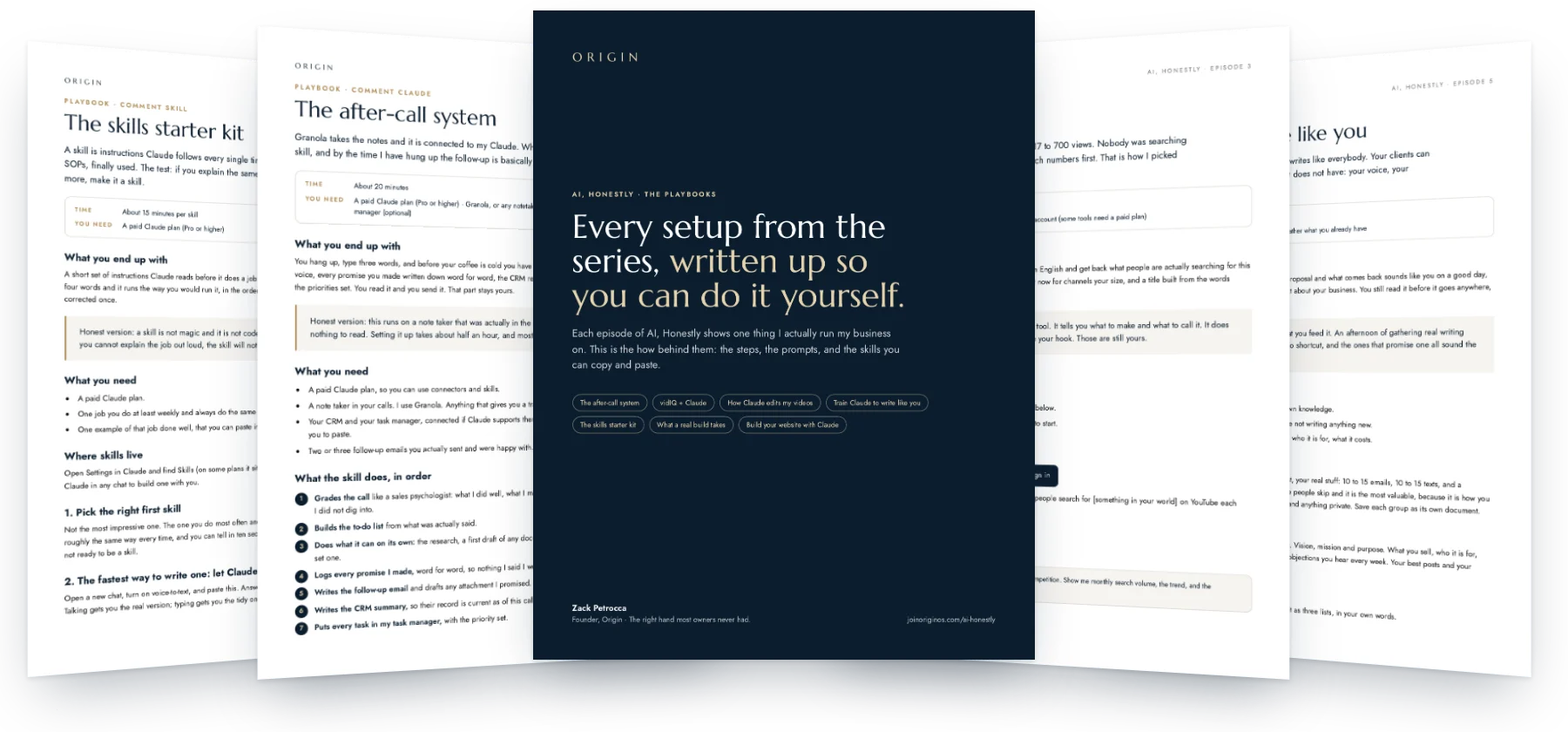
- Episode 2 The after-call system The skill that grades the call, logs every promise, writes the follow-up and updates the CRM.
- Episode 3 vidIQ + Claude The 30-second setup and the five prompts I use to pick every video before I shoot it.
- Episode 4 How Claude edits my videos The honest setup behind the series, and the edit rules that keep every video on brand.
- Episode 5 Train Claude to write like you Your voice, your company and your rules in one place, read before it writes anything.
- Episode 8 The skills starter kit The prompt that makes Claude interview you and write the skill, plus three to start with.
- Episode 17 Build your website with Claude The honest process behind a 72-page site: the words first, one page at a time, and the phone test that makes it feel like you.
While you are here